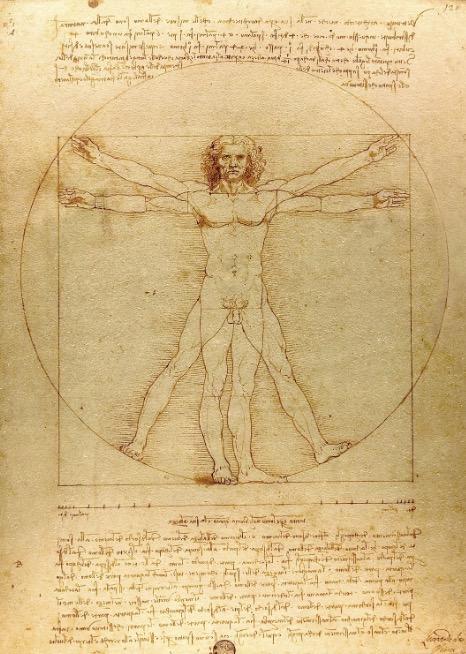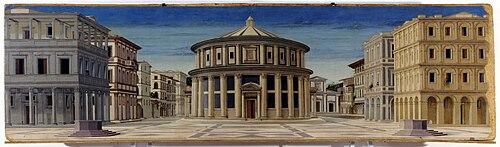
In Florence, the concept of a piazza as a community center is very traditional, and is alive and well today. When Renaissance architects were building the core monuments of Florence, many streets were designed to host a center square for societal use, whether recreational, governmental, religious or charitable. As a whole, the city has some grid-like streets that intersect, with a “forum” (city-center) in the middle. The street-grid design was mapped onto the ruins of the Roman colony Florentia, which stood in the same place Florence does now. While this may seem like vague guidelines for structuring a city, there was a philosophical interpretation of these ideas later on. Transitioning from the gothic style of the Medieval period, the beauty of the Renaissance was meant to create a more balanced, philanthropic and communal approach to society. Da Vinci’s ‘Vitruvian Man’, which is a commonly used diagram of humanism, is a mathematically accurate depiction of two male bodies. One is centered in a circle, and one is standing on a square. In this diagram, we were taught that the circle is interpreted as infinite existence, and the square represents finite existence, which were ideas at the core of the Renaissance. Humans are a powerful creation, and despite our finite existence similar to most species, we possess something otherworldly in spirit. It is a poetic approach that historians have taken when studying the architecture— displayed in the "Ideal City," an iconic piece with no known author, in which the surrounding buildings are made up of squares, and the city-center has a circular domed roof!
Florence is notably rich in human culture, which has visibly and intangibly given the city a specific essence.