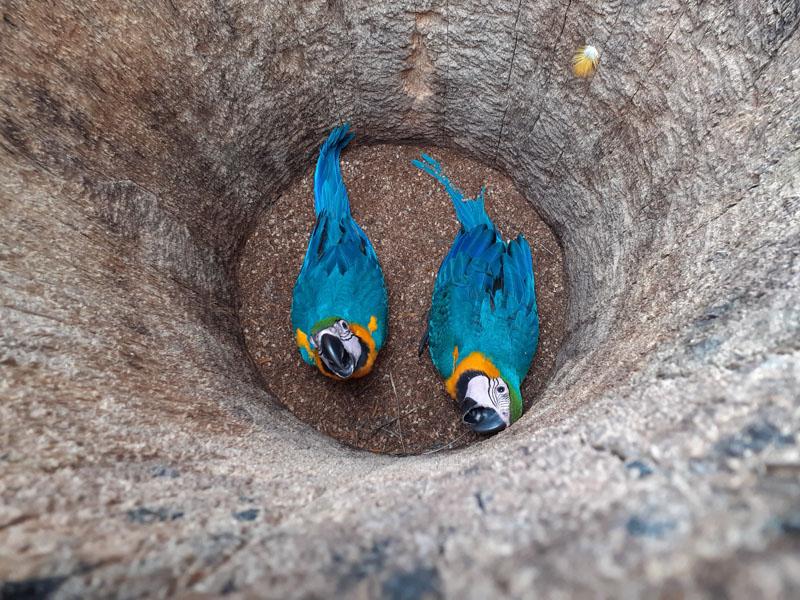
I knew that the Pantanal region here in Brazil was known for these beautiful birds when I arrived, but I was so surprised when I first saw one! My third week in Dourados, I saw a Red and Green Macaw soar past me on campus. Their red feathers stick out so vividly against the blue sky, so it felt like such a gift to see it. I always find myself surprised to see one, even though this is their natural habitat. Most recently, I saw a pair of Blue and Yellow Macaws perched on a lightpost near our bus in Campo Grande. This is the closest I have seen one in the wild, and I was even more surprised to see them in the city.
Macaws live both in forested and wetland regions, as well as in cities. Thanks to organizations dedicated to Macaw conservation, organizations are now supporting and studying Red and Green Macaws and Blue and Yellow Macaw populations in cities like Campo Grande. Campo Grande is the biggest city in Matto Grosso do Sul, and macaws can be seen in the city since the early 2000s, although they prefer to remain near green areas. Outside of Brazil, they can also be found in Panama, Colombia, the Guinas, Ecuador, Peru, Bolivia, Paraguay, and Argentina. They depend on wooded areas with lots of vegetation, and generally prefer canopy environments.
Macaws thrive in environments with lots of vegetation, because their diet depends on the seeds, fruits, sprouts, and plants produced in them. Macaws have a strong beak, which they can use to cut into nuts. Macaws prefer to stay in high, canopy spaces. They depend on tree hollows as nesting spaces.