Kruger National Park
The next leg of our trip took us east to Kruger National Park, about a two-hour flight from Cape Town. We landed at Hoedspruit, a small regional airport that handles only a handful of planes at a time, before continuing on to Thornybush, a private game reserve that borders the greater Kruger ecosystem. Kruger is unique in that it is not a single, isolated park, but part of a much larger, interconnected conservation area. The central national park is surrounded by numerous privately owned reserves that are formed by multiple landowners working together. Fences have been removed from the Kruger National Park border to allow wildlife to move freely across boundaries. These reserves play a critical role in conservation through coordinated anti-poaching efforts that protect high-value species like rhinos, elephants, and pangolins.
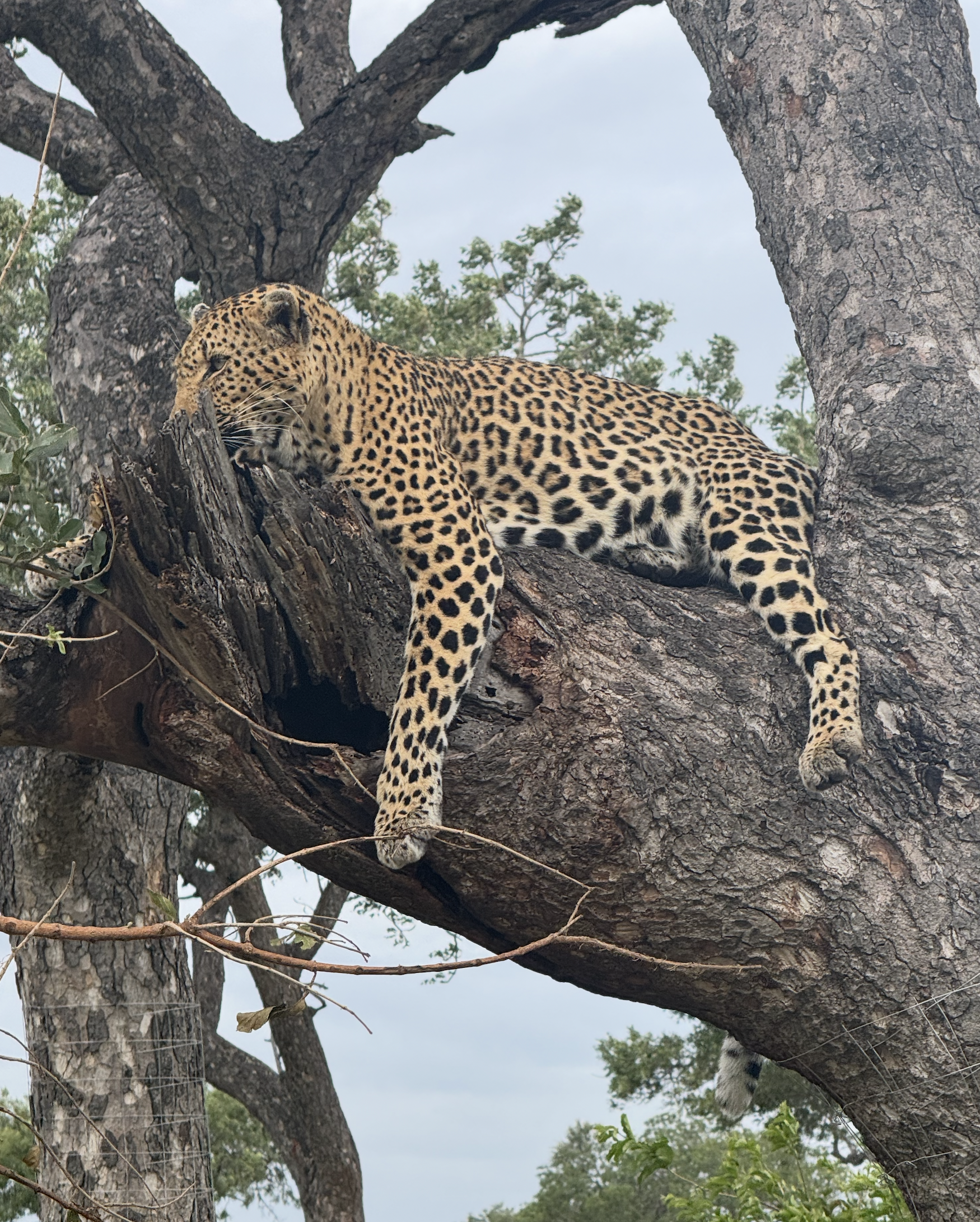
Compared to other regions in southern Africa, Kruger is especially known for its density of large predators. During our time in Thornybush, we saw multiple lions, including a pride composed of four dominant brothers and several females. One of the most memorable moments was watching two lionesses and a male approach and join another group of lions. The interaction happened just feet from our vehicle and was a close up view of how prides reunite and reinforce social bonds (which I learned tend to go against their instincts). We also saw the reserve’s elusive leopards, including a well-known blue-eyed female that is a local icon. We were also able to see several white rhinoceroses, one of the most heavily protected species in the region. Unlike black rhinos, which are more solitary and aggressive, white rhinos are generally more social and graze in open areas.